<?xml version="1.0" encoding="utf-8"?><feed xmlns="http://www.w3.org/2005/Atom" ><generator uri="https://jekyllrb.com/" version="3.10.0">Jekyll</generator><link href="https://www.openvax.org/blog/feed.xml" rel="self" type="application/atom+xml" /><link href="https://www.openvax.org/" rel="alternate" type="text/html" /><updated>2026-11-06T20:09:04-05:00</updated><id>https://www.openvax.org/blog/feed.xml</id><title type="html">OpenVax</title><subtitle>Open-source software for personalized cancer vaccines.</subtitle><entry><title type="html">OpenVax Neoantigen Prediction Pipeline: A Tutorial</title><link href="https://www.openvax.org/blog/openvax-neoantigen-prediction-pipeline-a-tutorial" rel="alternate" type="text/html" title="OpenVax Neoantigen Prediction Pipeline: A Tutorial" /><published>2020-10-20T21:48:23-04:00</published><updated>2020-10-20T21:48:23-04:00</updated><id>https://www.openvax.org/blog/openvax-neoantigen-prediction-pipeline-a-tutorial</id><content type="html" xml:base="https://www.openvax.org/blog/openvax-neoantigen-prediction-pipeline-a-tutorial"><![CDATA[<p>We’ve previously written about the OpenVax <a href="/blog/computational-pipeline-for-neoantigen-vaccine-trials-at-mount-sinai">neoantigen prediction pipeline,</a> which is the computational basis of 3 clinical trials at Mount Sinai. The purpose of this post is to provide a quick-start tutorial for using our pipeline on your own data to predict cancer neoantigens and select peptide vaccine contents, aiming to elicit a T cell response against those neoantigens.</p>

<p>In a nutshell, the OpenVax pipeline is a Dockerized end-to-end workflow using <a href="https://snakemake.readthedocs.io/en/stable/">Snakemake</a> that starts with raw tumor/normal sequencing data and does all the necessary processing to generate neoantigen predictions. It is easy to set up and run, contains all needed dependencies, and does not require a cluster. All you need is a Docker installation and a relatively beefy machine - we run it on a 24-core server, but 16 cores should be enough as well.</p>

<h2 id="overview">Overview</h2>

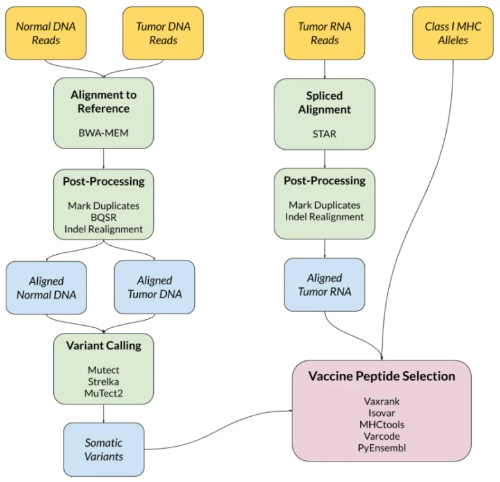
<p>These are the steps performed by the OpenVax pipeline:</p>

<ul>
  <li>Tumor and normal whole exome sequencing FASTQ files are aligned to a particular reference genome using bwa mem. RNA-seq of the tumor sample is aligned by STAR to the same reference genome. (We generally use GRCh37+decoy sequences or GRCh38.)</li>
  <li>Aligned tumor and normal exome reads pass through several steps using GATK 3.7: MarkDuplicates, IndelRealigner, BQSR.</li>
  <li>Aligned RNA-seq reads are grouped into two sets: those spanning introns and those aligning entirely within an exon (determined based on the CIGAR string). The latter group is passed through IndelRealigner, and the two groups of reads are merged.</li>
  <li>Somatic variant calling is performed by running Mutect 1.1.7, Mutect 2, and/or Strelka version 1. The pipeline configuration, which we go into below, specifies which of those 3 variant callers the pipeline should run.</li>
  <li>Once both somatic variants and aligned RNA are ready, a custom tool called Vaxrank coordinates variant effect annotation, expression estimation, and MHC binding prediction. Vaxrank prioritizes somatic variants based on expression and predicted MHC class I binding affinity.</li>
</ul>

<p><img src="/blog/images/openvax-neoantigen-prediction-pipeline-a-tutorial/pipeline-overview.png" alt="Flowchart of the OpenVax pipeline. Normal and tumor DNA reads are aligned with BWA-MEM, post-processed (duplicate marking, BQSR, indel realignment) and passed to variant calling with Mutect, Strelka and MuTect2. Tumor RNA reads are aligned with STAR and post-processed. Somatic variants, aligned tumor RNA and class I MHC alleles feed vaccine peptide selection with Vaxrank, Isovar, MHCtools, Varcode and PyEnsembl." /></p>

<h2 id="getting-started">Getting Started</h2>

<p>The OpenVax pipeline assumes you have the following datasets:</p>

<h3 id="sample-data">Sample data</h3>

<p>You will need to provide tumor and normal whole exome sequencing data, as well as tumor RNA-seq data. These files need to be in gzip-compressed FASTQ format. The pipeline also expects as input a list of MHC class I alleles for the individual.</p>

<h3 id="reference">Reference</h3>

<p>You will need to provide a reference genome and associated files:</p>

<ul>
  <li>Reference sequence file (FASTA)</li>
  <li>Known transcripts file (GTF)</li>
  <li>dbSNP known mutation file for your reference genome (VCF)</li>
</ul>

<h2 id="installation">Installation</h2>

<p>To install the latest version of the OpenVax pipeline from Dockerhub, run this one-liner:</p>

<div class="language-plaintext highlighter-rouge"><div class="highlight"><pre class="highlight"><code>docker pull openvax/neoantigen-vaccine-pipeline:latest
</code></pre></div></div>

<p>Verify everything installed correctly and see all available pipeline options (e.g. ability to execute a dry run listing all commands, specify memory/CPU resources for the pipeline, and others):</p>

<div class="language-plaintext highlighter-rouge"><div class="highlight"><pre class="highlight"><code>docker run openvax/neoantigen-vaccine-pipeline:latest -h
</code></pre></div></div>

<h2 id="setup">Setup</h2>

<p>You run the pipeline by invoking a Docker entrypoint in the image, giving it three directories as mounted Docker <a href="https://docs.docker.com/storage/volumes/">volumes</a>:</p>

<ul>
  <li>/inputs: FASTQ files and a configuration YAML (see example YAML <a href="https://github.com/openvax/neoantigen-vaccine-pipeline/blob/master/test/idh1_config.yaml">here</a>)</li>
  <li>/outputs: directory to write results to</li>
  <li>/reference-genome: reference genome data, may be shared across pipeline runs</li>
</ul>

<p>Make sure that all 3 directories are world-writable - the Docker pipeline runs as an unprivileged user, and the pipeline will need to write data to one or more of these directories.</p>

<p>Let’s say you want to run the pipeline using the GRCh38 reference genome. If you’re using our provided processed files, download and uncompress them (and make the reference genome directory world-writable):</p>

<div class="language-plaintext highlighter-rouge"><div class="highlight"><pre class="highlight"><code>gsutil -m cp gs://reference-genomes/grch38.tar.gz /your/path/to/reference/genome/
cd /your/path/to/reference/genome/ &amp;&amp; tar -zxvf grch38.tar.gz
chmod -R a+w grch38
</code></pre></div></div>

<h2 id="configuration">Configuration</h2>

<p><img src="/blog/images/openvax-neoantigen-prediction-pipeline-a-tutorial/example-config.png" alt="Example YAML config: sample-specific settings (sample id, MHC alleles, and single-end FASTQ files for normal, tumor and RNA) followed by pipeline settings (work directory, b37decoy reference files, the netmhcpan-iedb MHC predictor, and the mutect and strelka variant callers)." /></p>

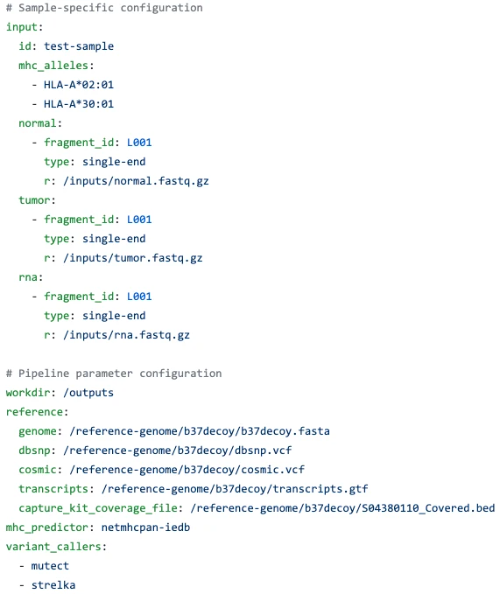
<p>An OpenVax pipeline YAML config file contains sample-specific settings and tool configurations that may be common across samples and shared in multiple pipeline runs. This config file needs to live in the directory /your/path/to/fastq/inputs, the same directory as your input FASTQ files. Some notes about this:</p>

<ul>
  <li>All paths in the config are expected to be relative to the inputs, outputs, and reference genome directories you’re mounting as Docker volumes.</li>
  <li>In most cases, you should only need to edit the sample-specific configuration (first half of the config YAML file).</li>
  <li>You can list up to 6 MHC class I alleles for your sample. Make sure that each allele is supported by NetMHCpan; otherwise no vaccine peptide results will be returned.</li>
  <li>The sample ID will determine the subdirectory where the results get written, so you should use a unique sample name for each pipeline run.</li>
  <li>If you have data in paired-end FASTQ files, the two files must be specified as “r1” and “r2” entries instead of the singular entry in the config template. You’ll also need to change the “type” to “paired-end”.</li>
  <li>If you have data for a single sample that’s spread across multiple sequencing runs or lanes, this can be accommodated also: the “tumor”, “normal”, and “rna” sections in the configuration file each contain a list of fragments. This allows for multiple list elements, as long as each entry has a distinct “fragment_id” value. For example, if the tumor RNA data comes from multiple sequencing runs, you can add another list element to the “rna” block with “fragment_id: L002”.</li>
</ul>

<h2 id="test-run">Test run</h2>

<p>For an example run, try starting with test data from our GitHub repo, consisting of a YAML config file and two small FASTQ files of reads overlapping a single somatic mutation, set up to run using the GRCh38 reference genome. First, download this reference genome as described in the Setup section above. For this simple test, we will re-use the tumor DNA sequencing as our RNA reads. Download the test data from these files to the directory you’ll have mounted as your /inputs volume:</p>

<div class="language-plaintext highlighter-rouge"><div class="highlight"><pre class="highlight"><code>cd /your/path/to/fastq/inputs
wget https://github.com/openvax/neoantigen-vaccine-pipeline/raw/master/test/idh1_config_grch38.yaml
wget https://github.com/openvax/neoantigen-vaccine-pipeline/raw/master/datagen/idh1_r132h_normal.fastq.gz
wget https://github.com/openvax/neoantigen-vaccine-pipeline/raw/master/datagen/idh1_r132h_tumor.fastq.gz
</code></pre></div></div>

<p>After you create your /outputs directory, we may now run the pipeline:</p>

<div class="language-plaintext highlighter-rouge"><div class="highlight"><pre class="highlight"><code>docker run -it \
-v /your/path/to/fastq/inputs:/inputs \
-v /your/path/to/pipeline/outputs:/outputs \
-v /your/path/to/reference/genome:/reference-genome \
openvax/neoantigen-vaccine-pipeline:latest \
--configfile=/inputs/idh1_config_grch38.yaml
</code></pre></div></div>

<p>The first time you run this, it may take several minutes as necessary processing files are being downloaded and cached. The output will be a set of ranked variants and proposed vaccine peptide results in several file formats, including basic text (ASCII) and PDF. If everything works correctly, you should see a single IDH1 R132H variant in the final output.</p>

<h2 id="what-if-i-want-to-use-openvax-to-just-call-somatic-variants">What if I want to use OpenVax to just call somatic variants?</h2>

<p>You can also run the OpenVax pipeline just to call somatic variants, if you don’t have tumor expression data or MHC alleles for your sample. Simply use the same pipeline configuration, but omit the tumor RNA part of the sample as well as HLA alleles - this will call and write MuTect and Strelka variants into their own respective VCFs! See an example of a variant-calling-only pipeline config <a href="https://github.com/openvax/neoantigen-vaccine-pipeline/blob/master/test/idh1_config_dna_only.yaml">here</a>.</p>

<p>There’s all sorts of other intermediate output in the pipeline as well in the pipeline - for a description of that, or for any other details about the pipeline, check out our <a href="https://github.com/openvax/neoantigen-vaccine-pipeline">README</a> on GitHub. And if you have any other questions, please contact <a href="mailto:julia@openvax.org">julia@openvax.org</a>.</p>]]></content><author><name>Julia Kodysh</name></author><summary type="html"><![CDATA[We’ve previously written about the OpenVax neoantigen prediction pipeline, which is the computational basis of 3 clinical trials at Mount Sinai. The purpose of this post is to provide a quick-start tutorial for using our pipeline on your own data to predict cancer neoantigens and select peptide vaccine contents, aiming to elicit a T cell response against those neoantigens.]]></summary></entry><entry><title type="html">Computational Pipeline for Neoantigen Vaccine Trials at Mount Sinai</title><link href="https://www.openvax.org/blog/computational-pipeline-for-neoantigen-vaccine-trials-at-mount-sinai" rel="alternate" type="text/html" title="Computational Pipeline for Neoantigen Vaccine Trials at Mount Sinai" /><published>2018-08-03T16:08:53-04:00</published><updated>2018-08-03T16:08:53-04:00</updated><id>https://www.openvax.org/blog/computational-pipeline-for-neoantigen-vaccine-trials-at-mount-sinai</id><content type="html" xml:base="https://www.openvax.org/blog/computational-pipeline-for-neoantigen-vaccine-trials-at-mount-sinai"><![CDATA[<p>Cancer immunotherapy aims to recruit the body’s own immune system to attack a tumor, which requires that the tumor be recognized as “foreign” by the immune system. An exciting line of research indicates that genetic mutations acquired by cancer cells during tumor development can be the basis for this recognition when they result in mutated protein fragments displayed to immune cells (also known as “neoantigens”). Because neoantigens distinguish tumor cells from normal cells, they create actionable targets for the body’s immune system.</p>

<p>Sometimes, the immune system fails to initiate a response against a tumor. In these cases, it’s reasonable to imagine that a vaccine might help, and indeed personalized cancer vaccination is an emerging branch of cancer immunotherapy with many ongoing clinical trials. The idea behind neoantigen vaccines is to train the patient’s immune system to mount a response against the specific mutated cancer proteins present in his or her tumor. As a personalized therapy, it is different from other immunotherapy approaches like checkpoint blockade, where the immune system as a whole is stimulated but not directed toward a specific antigen.</p>

<p>Earlier this year, we published a <a href="https://www.frontiersin.org/articles/10.3389/fimmu.2017.01807/full">paper</a> describing the <a href="https://clinicaltrials.gov/ct2/show/NCT02721043">Mount Sinai PGV-001 personalized vaccine clinical trial</a> and the computational pipeline we built to support it, along with <a href="http://www.hammerlab.org/">Hammerlab</a> members Isaac Hodes, Arman Aksoy, and Seb Mondet. We have built an updated version of the pipeline that is a <a href="https://www.docker.com/">Dockerized</a> end-to-end workflow that starts with raw tumor/normal sequencing data and does all the necessary processing to generate neoantigen predictions. It is easy to set up and run, contains all needed dependencies, and does not require a cluster. We’ve made it available as a <a href="https://hub.docker.com/r/openvax/neoantigen-vaccine-pipeline/">public Docker image</a>. For detailed instructions on how to run the pipeline, please see the <a href="https://github.com/openvax/neoantigen-vaccine-pipeline/blob/master/README.md">README</a>. Like other tools we’ve developed at the OpenVax research lab, this pipeline is open-source and available on <a href="https://github.com/openvax/neoantigen-vaccine-pipeline/">GitHub</a>.</p>

<p>In a nutshell, our neoantigen pipeline calls somatic variants and uses a suite of tools we’ve developed (<a href="https://github.com/openvax/vaxrank">vaxrank</a>, <a href="https://github.com/openvax/isovar">isovar</a>, <a href="https://github.com/openvax/mhctools">mhctools</a> and others) to prioritize those mutations for vaccination based on tumor RNA expression and the likelihood that tumor cells will present these mutated protein fragments to the immune system. Note that while the pipeline supports FASTQ-to-vaccine-peptide processing, which includes neoantigen prediction and ranking, it can also be used just for germline and somatic variant calling in the absence of tumor RNA sequencing data.</p>

<p>We hope that this pipeline can enable other research groups in their own neoantigen or variant calling work. Please don’t hesitate to reach out to us with any questions or suggestions.</p>]]></content><author><name>Julia Kodysh</name></author><summary type="html"><![CDATA[Cancer immunotherapy aims to recruit the body’s own immune system to attack a tumor, which requires that the tumor be recognized as “foreign” by the immune system. An exciting line of research indicates that genetic mutations acquired by cancer cells during tumor development can be the basis for this recognition when they result in mutated protein fragments displayed to immune cells (also known as “neoantigens”). Because neoantigens distinguish tumor cells from normal cells, they create actionable targets for the body’s immune system.]]></summary></entry><entry><title type="html">GLIPH &amp;amp; TCR clustering</title><link href="https://www.openvax.org/blog/gliph-tcr-clustering" rel="alternate" type="text/html" title="GLIPH &amp;amp; TCR clustering" /><published>2018-06-27T14:33:53-04:00</published><updated>2018-06-27T14:33:53-04:00</updated><id>https://www.openvax.org/blog/gliph-tcr-clustering</id><content type="html" xml:base="https://www.openvax.org/blog/gliph-tcr-clustering"><![CDATA[<p><a href="http://lasersonlab.org/">Uri Laserson</a> organized a delightful class at Mount Sinai called <a href="http://bit.ly/SeqImm-2018">Applications of DNA Sequencing and Synthesis to Immunology</a>. It was a survey of several related emerging trends in genomics and immunology with each week was structured around a pair of papers presented by students. For the first week, I presented <a href="https://www.ncbi.nlm.nih.gov/pmc/articles/PMC5794212/">Identifying specificity groups in the T cell receptor repertoire</a> (a.k.a. “the GLIPH paper”) by <a href="https://twitter.com/curlyjunglejake">Jake Glanville</a>, <a href="http://med.stanford.edu/davislab.html">Mark Davis</a> (and many other people).</p>

<p>The basic gist of GLIPH (<em>Grouping of Lymphocyte Interactions by Paratope Hotspots)</em> is that since <a href="https://en.wikipedia.org/wiki/T-cell_receptor">TCR</a>s with similar antigen specificity have been observed to have similar CDR3 sequences then clustering TCRs in the space of amino acid sequences will also effectively cluster them by specificity. The GLIPH algorithm links two TCRs into a cluster by either of the following heuristics:</p>

<ul>
  <li><em>global</em>: nearly identical sequences (differing by only 1 amino acid)</li>
  <li><em>local</em>: sharing distinctive k-mers (for k=2,3,4) in the region of the TCR most likely to contact the peptide, where distinctiveness is defined as being comparatively rare in a reference population of naive T-cells</li>
</ul>

<p>In addition to these linkage criteria, GLIPH also uses a variety of features to score the quality/purity of each cluster. The complete algorithm schematic is given in Extended Data Figure 3:</p>

<p><img src="/blog/images/gliph-tcr-clustering/gliph-overview.png" alt="Overview of GLIPH: structural constraints feed global similarity and motif search, which drive TCR clustering; each cluster is scored on V-segment, CDR3 length, clonal expansion, HLA allele and motif to give TCR specificity group scores." /></p>

<p>One of the main evaluations of GLIPH is summarized in Extended Data Figure 4c:</p>

<p><img src="/blog/images/gliph-tcr-clustering/gliph-extended-data-fig-4c.png" alt="Extended Data Figure 4c from the GLIPH paper: percent of TCRs clustered versus correct specificity call for GLIPH, CD-HIT 0.8 and 0.9, global distance 1 and 2, and local motifs with and without structural filtering. GLIPH sits near 14% clustered and 94% correct." /></p>

<p><strong>Data:</strong> The authors created a dataset of TCRs with known antigen specificity by collecting blood samples from 33 healthy donors and sorting their T-cells using 8 pMHC <a href="http://www.tcells.org/scientific/pMHC/pMHCtetramers/">tetramers</a> containing known <a href="https://en.wikipedia.org/wiki/Immunodominance">immunodominant</a> epitopes from CMV, EBV and flu. The sequenced TCRs of these antigen specific T-cells can then be used as inputs to any clustering approach and the specificity labels can be used to evaluate the purity of generated clusters.</p>

<p><strong>Sensitivity vs. Purity:</strong> In the above figure, each dot represents a different clustering algorithm. The X-axis is the sensitivity of the clustering (what fraction of TCRs are assigned to clusters) and Y-axis is the average purity of each cluster (where 100% means that any linked TCRs always share antigen specificity). The two linkage criteria used by GLIPH are “local +struct” and “global dist=1”. The label “+struct” just means that the comparison of k-mers occurs only in the <a href="https://en.wikipedia.org/wiki/Complementarity-determining_region">CDR3</a> region of the TCR, rather than the whole sequence. As you can see, both of these clustering rules perform almost as well as the GLIPH algorithm itself.</p>

<p><strong>Pruning after clustering?</strong> I think GLIPH performs some kind of filtering on low quality clusters which was either unstated or I simply missed in my reading of the paper). If we were to simply link TCRs which satisfy either one of the independent “local +struct” and “global dist=1” criteria we would expect to see an increase on the X-axis to at least the ~15% achieved by “global dist=1” clustering and likely to an even higher sensitivity (20% or beyond). This sensitivity would most likely be accompanied by a decrease in cluster purity, due to spurious TCR linkages. To achieve a lower sensitivity and higher cluster purity requires the elimination of some cluster linkages. Maybe this final pruning step is obvious from the source code but reading Perl has never come easily to me.</p>

<p><strong>Broader applications?</strong> Since all of the approaches discussed in the GLIPH paper are different approaches to unsupervised clustering, they rely on generating relatively “pure” clusters for reasoning about the specificity of TCRs with unknown function. While the linkage method presented might achieve tolerable cluster purities when the labels are restricted to 8 known epitopes, I wonder how well this approach scales in the presence of additional labels. If a high throughput tetramer assay were used to identify TCR specificities across hundreds or thousands of epitopes, would all the clusters be hopelessly impure?</p>]]></content><author><name>Alex Rubinsteyn</name></author><category term="immunology" /><summary type="html"><![CDATA[Uri Laserson organized a delightful class at Mount Sinai called Applications of DNA Sequencing and Synthesis to Immunology. It was a survey of several related emerging trends in genomics and immunology with each week was structured around a pair of papers presented by students. For the first week, I presented Identifying specificity groups in the T cell receptor repertoire (a.k.a. “the GLIPH paper”) by Jake Glanville, Mark Davis (and many other people).]]></summary></entry></feed>